Aryaan Peshoton: portfolio content
Full text of aryaanpeshoton.com, written as a single markdown document. The same content is published at https://aryaanpeshoton.com/llms-full.txt for AI agents. The React source in `src/` is the source of truth for layout and wording.
Summary
Aryaan Peshoton is an AI, machine learning, and data science engineer completing an MS in Artificial Intelligence at Northwestern University (Evanston, IL, Sep 2025 to Dec 2026, GPA 4.0/4.0). He is open to full-time AI and ML roles from December 2026.
Bio, as published on the site:
AI has had me hooked since 2021, when I chose it over robotics for my bachelor's after realizing how much meaningful insight can come from under-utilized data. Over time, I discovered that I love the data as much as I love building models, which brought me to Northwestern to further my expertise. If you share my enthusiasm, I'd love to connect and exchange ideas about niche ML topics or the ethical considerations that come with this ever-evolving field.
Contact and links
- Website: https://aryaanpeshoton.com/
- Email: aryaanpeshoton2027@u.northwestern.edu
- Phone: 773-681-2029
- Location: Evanston, IL
- LinkedIn: https://www.linkedin.com/in/aryaan-peshoton
- GitHub: https://github.com/AryaanPe
- Northwestern profile: https://www.mccormick.northwestern.edu/artificial-intelligence/people/students/2025-2026/peshoton-aryaan.html
- Resume (PDF): https://aryaanpeshoton.com/Aryaan_Peshoton_Resume.pdf
- Interactive 3D session viewer: https://aryaanpeshoton.com/pose3d-viewer/index.html
Headline stats
- 24k nodes in the FIBO and MISMO knowledge graph built at Mphasis
- 4.0 GPA in the Northwestern MS
- 4 AI internships since 2023
- 0 fabricated citations in any evaluation run of the Mphasis agent
Education
Northwestern University
- Degree: MS, Artificial Intelligence
- Location: Evanston, IL
- Dates: Sep 2025 to Dec 2026
- GPA: 4.0 / 4.0
- Courses: Deep Learning; Generative AI; Advanced Algorithms for ML; Machine Perception of Music; Representation, Reasoning and Language; AI Industry Practicum
NMIMS (MPSTME)
- Degree: BTech, Artificial Intelligence
- Location: Mumbai, India
- Dates: 2021 to 2025
- GPA: 3.52 / 4.0
- Courses: Reinforcement Learning; Computer Vision; Natural Language Processing; Recommendation Systems; Advanced Topics in ML; Applied Time Series Analysis
Experience
AI intern, Mphasis.AI (New York), Jun 2026 to Aug 2026
Building a knowledge graph over two mortgage-finance standards, and the agents that answer questions against it without inventing sources.
- Context: Mortgage technology runs on two dense standards. MISMO defines every datapoint on a loan file, and FIBO is a formal OWL ontology of finance. Language models answer fluently about both, and sometimes invent the section numbers they cite.
- What was built: MISMO and FIBO parsed from their native formats (FIBO from OWL with rdflib, the MISMO Logical Data Dictionary from its spreadsheet with openpyxl) into one graph of 24,000 nodes and 52,000 edges, joined by 48 cross-standard links verified by hand. Retrieval runs in five stages (prefix trie, keyword, fuzzy, FAISS semantic search, then a bge-reranker-v2-m3 rerank) and feeds two ReAct agents: a 13-tool FIBO traversal agent and an 8-tool MISMO containment agent. Every draft answer passes an OWL axiom check and a citation audit before release.
- Result: 25 of 27 on a structured evaluation set, zero fabricated citations across every run. On a real ULAD loan-application XML it resolved 56 of 57 elements to graph nodes with no invalid enumeration values. The pipeline is deployed as a 10-tool MCP service for Claude Desktop and GitHub Copilot, with authenticated client access, schema-validated tool inputs, bounded retrieval, request limits, and timeouts.
- Metrics: 24k graph nodes; 25/27 eval score; 56/57 ULAD elements resolved; 0 fabricated citations.
- Tags: Knowledge graphs, OWL / rdflib, ReAct agents, FAISS, bge reranker, MCP.
Data science intern, Finarkein Analytics (Mumbai), Nov 2024 to Jul 2025
Turning scanned bank statements into structured, queryable transaction data, with retrieval on top.
- Context: Indian bank statements arrive as scans in hundreds of layouts, often skewed, with broken table lines and stamps over the text. Every client onboarding meant someone retyping them by hand.
- What was built: a 12-step OCR pipeline that repairs the page before reading it (adaptive line repair, artifact removal, contour-based cell detection). SIFT/ORB logo matching identifies the bank and reuses a cached layout template, so repeat formats skip most of the work. Counterparty extraction combines frequency-based tokenization, regex masking, and KDTree search, with a fine-tuned RoBERTa normalizing 7,000+ company-name variants. A ChromaDB retrieval layer lets clients query their own spending in plain language.
- Result: manual digitization effort down roughly 80%, OCR time down 60% on repeat documents, counterparty matching above 90% across 50,000+ records.
- Tags: OCR, OpenCV, SIFT / ORB, RoBERTa, ChromaDB.
ML intern, Asset Analytix (Mumbai), May to Jul 2024
Making a decade of maintenance records searchable, then predicting which machines fail next.
- Context: years of technician service records sat in a legacy database nobody could search. Each technician wrote in their own shorthand, so exact-match lookups failed.
- What was built: an embeddings-based retrieval chatbot over 10,000+ records that answers maintenance questions across machines and across each technician's vocabulary. Random Forest and XGBoost models score each machine's failure risk from the same logs.
- Result: the database became a searchable interface, and the risk models held 85% precision under cross-validation.
- Tags: Embeddings, Retrieval, XGBoost, Random Forest.
AI intern, Max Life Insurance (Mumbai), May to Jul 2023
Pulling usable signal out of scanned medical documents and training models to read them.
- Context: underwriting depends on medical evidence that arrives as scans: ECG printouts and chest X-rays from clinics with very different equipment and quality.
- What was built: waveform extraction that lifts the ECG trace off the printed grid with adaptive thresholding and parallelized segmentation. For X-rays, a standardization pass across five-plus clinical sources, then a residual CNN for pathology classification.
- Result: 91% classification accuracy on public data, 86% on the messier in-house clinical sets.
- Tags: Medical imaging, Residual CNN, Signal processing.
Projects
Projects are listed in this order on the site.
Exam proctoring (Computer vision)
Capstone project. Online exams are easy to cheat on, so the system tries to close every gap it can with one webcam.
- How it works: a Flask and SocketIO server streams an annotated webcam feed to the browser. A custom YOLOv5 detector flags phones, a Keras CNN classifies liveness, face_recognition encodings check identity, and weighted Laplacian and Gaussian blur-artifact scores flag virtual or replayed cameras. Questions load from a spreadsheet. Gaze work starts from eye crops labelled with cursor position and trains a small PyTorch CNN to predict screen x and y.
- Specs: Flask + SocketIO webcam stream; custom YOLOv5 objects; Keras CNN liveness; face_recognition identity; Laplacian + Gaussian virtual camera check; eye crops and cursor labels for gaze; PyTorch CNN for screen x and y; spreadsheet-backed exam flow.
- Code: https://github.com/AryaanPe/CAPSTONE-PROCTORAI
Motion transfer GAN (Generative vision)
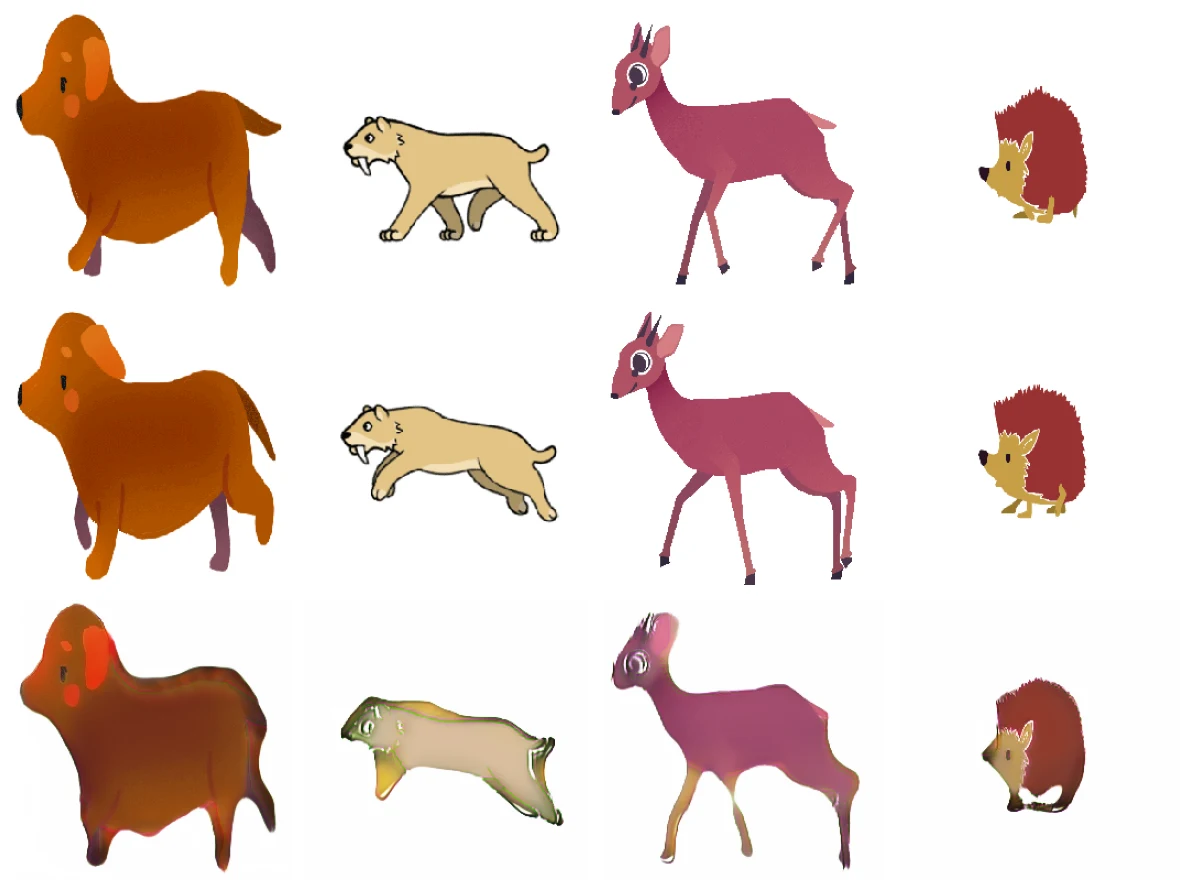
Can a still drawing act out a video it has never seen? The motion-transfer GAN was written from scratch in PyTorch to find out.
- How it works: built around the First Order Motion Model idea. StructureView extracts Sobel edges and a foreground mask, while an appearance encoder builds multi-scale source features. A part encoder turns spatial soft heatmaps into explicit x and y keypoints. MotionNet predicts dense flow, an occlusion network masks unreliable regions, and the synthesizer warps the source features at several scales. A spectral-normalized PatchGAN provides the adversarial signal.
- Specs: base idea First Order Motion Model; structure from Sobel edges and foreground mask; parts as spatial heatmaps to x and y keypoints; motion as dense flow with an occlusion mask; synthesis with multi-scale warped features; critic is a spectral-normalized PatchGAN.
- Code: https://github.com/AryaanPe/motion-transfer-gan
Endoscopy classifier (Medical imaging)
A pill-sized camera films the gut, and the rarest disease appears 180 times less often than healthy tissue. That imbalance was the main difficulty.
- How it works: three timm backbones (ResNet-50, DeiT-Base patch16-224, MobileNetV3-Large) each project to a shared 512-dimensional space. A learned attention block weighs and sums them. Inference is a cascade: a binary gate decides normal versus abnormal, then flagged frames run the ten-class head. Focal loss and a weighted sampler handle the class imbalance, and runs were selected on balanced accuracy in Weights & Biases.
- Specs: ResNet-50, DeiT and MobileNetV3 backbones; softmax attention fusion to 512-D; BCE gate to a 10-way head; focal loss and weighted sampler; Weights & Biases tracking. Validation: 92.9% accuracy, 83.1% balanced accuracy, 80.7% macro F1.
- Code: https://github.com/AryaanPe/VCap_CapsuleVision2024
3D pose reconstruction (3D vision, in progress)
Research at Northwestern, building a markerless 3D motion-capture pipeline for a freely moving subject filmed by six synced camera views.
- How it works: fixed cameras are calibrated against a 3D-printed target. DeepLabCut tracks 2D keypoints per view. A custom RANSAC-style consensus step triangulates them: for each keypoint and frame it tries camera-pair hypotheses and accepts an additional view only when it agrees with the others within a pixel threshold, so one bad camera cannot drag a point off. A separate pass applies temporal smoothing and bone-length constraints.
- Results: the six-camera rig calibrates to 2.15px reprojection error. A rigid skull-marker distance is reconstructed to within 2.2-2.8mm, and that precision reproduces on later sessions without recalibrating. A known calibration-object scale (4.0mm board squares) reconstructs at 4.17mm, a 1.04x ratio that rules out a scale bug. Frame coverage with at least 6 of 8 keypoints rose from 8,240 of 18,000 frames in the baseline to 16,466 of 18,000 in the repaired pipeline.
- Open problem: a seventh, moving zoom camera. Its position and focal length change every frame, so its pose is solved per frame with PnP against the triangulated points. This is not yet reliable. One fit placed the camera about 100 meters away while reporting under 2px reprojection error, which shows that low pixel error alone does not guarantee a correct pose.
- Interactive viewer: see the "3D mouse tracking" demo below.
- Specs: calibration with a 3D-printed target at 2.15px reprojection; DeepLabCut (ResNet101) 2D tracking; custom RANSAC consensus triangulation; 2.2-2.8mm cross-session precision; 91% frame coverage at 6+ of 8 keypoints; open problem is per-frame moving-camera pose (PnP).
TessMove (Applied CV, product)
A browser-based home exercise app for post-operative lower-limb rehabilitation. The camera tracks the body entirely on-device, and a rules engine counts reps, times holds, and flags form issues in real time. Source code is not published.
- How it works: MediaPipe's pose model runs compiled to WASM in the browser, so the camera feed never leaves the device. A One-Euro filter and a bone-length depth stabilizer clean up the raw landmarks. A JSON-driven finite-state machine scores reps against per-exercise thresholds, form rules with clinical rationale, and phase gating, with 18 exercises defined this way. A clinician dashboard assigns protocols and has to sign off each exercise's thresholds, hash-recorded, before patients can use them. The backend is intentionally minimal: Express with a JSON-file store and scrypt/HMAC auth, with no external database or auth provider.
- Limits stated on the site: there is no camera-pose normalization, so transverse-plane rotation measurements are not reliable, and a couple of exercises have weaker tracking than the rest. Clinical sign-off exists so thresholds are validated per exercise before real patient use.
- Specs: MediaPipe on-device via WASM; One-Euro filter with depth stabilizer; JSON-driven rules engine (FSM); 18 exercise configs with a clinical sign-off hash; Express and JSON store with scrypt/HMAC auth; no video recorded or uploaded.
Patent phrase matching (NLP)
Two patent phrases can mean the same thing or nothing at all, depending on the field. Built for a Kaggle competition.
- How it works: DeBERTa-v3 was chosen as the cross-encoder after a hyperband search against BERT-for-patents and ModernBERT. The input was rebuilt around the finding that 97% of score variance lives within anchor groups: anchor, target, the sibling candidates competing under the same anchor, and the full CPC subsection text, separated by a repurposed SEP token. Instead of full fine-tuning, wide LoRA adapts the query, key, value, and feed-forward projections on two learning rates, training 14M of 435M parameters. Five folds are ensembled.
- Specs: DeBERTa-v3 cross-encoder; hyperband over 3 models; wide LoRA on q/k/v and FFN; 14M of 435M trainable parameters (3.2%); dual learning rates for attention and FFN; final score 0.8636 Pearson over 5 folds.
- Code: https://github.com/AryaanPe/patent-phrase-finetune
Gesture gamepad (CV, input)
Playing games with bare hands: two hands become a controller with sticks and triggers.
- How it works: each hand drives half of a controller. The thumb's angle around its knuckle is an analog stick, the index finger's curl is a bumper, and the middle finger's curl is an analog trigger. MediaPipe's HandLandmarker tracks 21 landmarks per hand. The left stick is tilt-based and the right stick is position-based, both with a deadzone and exponential smoothing. A 35-frame calibration records each hand's neutral pose. Output goes through vgamepad as a virtual Xbox controller, and a bundled top-down twin-stick shooter tests it.
- Specs: MediaPipe HandLandmarker, 21 landmarks per hand; thumb motion for sticks; pinch gestures for buttons; middle-finger movement for triggers; vgamepad virtual Xbox output; twin-stick shooter as the test scene.
- Code: https://github.com/AryaanPe/CV-Virtual-Keyboard
SkAI flight rerouter (Applied ML)
A hackathon build: reroute flights around bad weather, and make the tradeoff clear enough for a dispatcher to trust. Reached the Datathon 2.0 final out of 300+ teams.
- How it works: a multi-layer perceptron reads airport weather and outputs an arrival-safety level. Airports flagged unsafe become blocked nodes on a city-to-city graph in NetworkX whose edge weights are flight times. Dijkstra finds the lowest-time path through the remaining safe airports. The output draws the original plan and the reroute together with the added time. The companion flight-ops interface wraps the route logic in Tkinter and adds a Random Forest maintenance service-status predictor.
- Specs: MLP over airport weather; NetworkX graph with flight-time edges; Dijkstra minimum-time routing; Tkinter operations UI; Random Forest service-status model; Datathon 2.0 finalist.
- Code: https://github.com/AryaanPe/SkAI---Flight-route-optimizer (model) and https://github.com/AryaanPe/flight-ops-gui (flight ops UI)
ElectronicBazar (Mobile)
A full Android storefront, from sign-in to an admin dashboard, built end to end.
- How it works: around 18 Java activities with RecyclerView adapters cover the retail loop. Firebase Authentication handles sign-up and login with a role flag separating customers from the admin account. The Firebase Realtime Database backs products, carts, and users. The customer side covers browse, product detail, cart, and checkout. The admin side is create, read, update, and delete over products and users.
- Specs: Java (Android); around 18 activities and adapters; Firebase Auth with roles; Realtime Database; customer and admin CRUD flows.
- Code: https://github.com/AryaanPe/MADproject
Demos
Demos are listed in this order on the site.
Super-resolution (GAN)
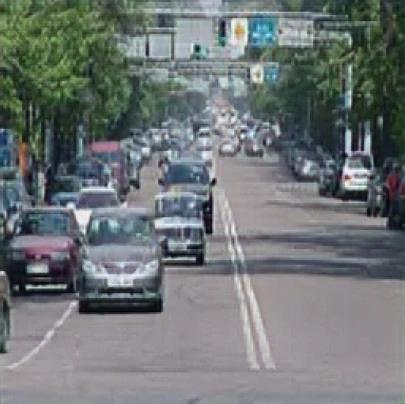
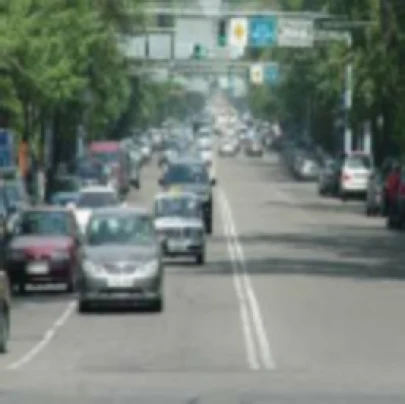
Bad video calls are frustrating. Instead of asking for more bandwidth, the receiving end rebuilds the missing detail. The demo is an interactive comparison slider showing low-resolution input against the upscaled output.
- How it works: two 2x models were trained on the same data, an SRGAN-style PyTorch generator and a smaller TensorFlow attention CNN. The GAN uses channel attention around eight residual blocks, a global skip, and nearest-neighbour upsampling followed by convolution. Its generator loss combines frozen VGG19 perceptual loss with adversarial BCE. The baseline is an encoder-decoder with a residual bottleneck, skip connections, and its own VGG perceptual term. Both run on the same validation frames, and every frame in the slider is saved, unedited model output.
- Specs: SRGAN-style GAN and attention CNN; GAN core of 8 residual blocks with channel attention; GAN loss of VGG19 perceptual plus BCE adversarial; baseline loss of MSE plus VGG19 perceptual; comparison on the same validation scenes; PyTorch and TensorFlow/Keras.
- Code: https://github.com/AryaanPe/super-resolution
3D mouse tracking (3D vision, CV)
Six synced cameras rebuild a freely moving mouse in 3D. This is the real session viewer from the research, embedded on the site, not a recreation.
- How it works: the six cameras are calibrated against a 3D-printed target at 2.15px reprojection error. DeepLabCut tracks 2D keypoints per view. The custom RANSAC-style consensus step triangulates them, then a temporal and bone-length constrained pass smooths the result.
- What the viewer shows: montage video across all camera views, a toggle between the original run and a repaired six-camera calibration, and diagnostic plots (per-keypoint reprojection error and smoothness checks) that showed one camera's orientation was the problem. Repairing it moved keypoint precision from 2.24mm to 2.19mm and frame coverage from 13,195 to 16,466 of 18,000 frames.
- Specs: calibration with a 3D-printed target at 2.15px; custom RANSAC consensus; 2.2-2.8mm cross-session precision; repaired run at 2.19mm and 16,466 of 18,000 frames; DeepLabCut (ResNet101) 2D tracking.
- Viewer: https://aryaanpeshoton.com/pose3d-viewer/index.html
Verity (Agents, evidence)
A data system that shows its work. Every claim is checked against the evidence it actually retrieved before it is shown.
- How it works: a local system ingests heterogeneous sources (CSV, Excel, JSON, Parquet, XML, PDF, DOCX, images, SQLite, SEC EDGAR filings, RDF/OWL ontologies) into one provenance-tracked workspace. Source adapters feed a profiler (types, nulls, keys), a schema-free relationship miner, and an optional ontology layer with bundled MISMO and FIBO packs. Entity and field matching combines TF-IDF and dense embeddings with reciprocal rank fusion, a cross-encoder rerank, and a gradient-boosted classifier over weak-labeled features, resolved to one-to-one assignments. A bounded ReAct agent answers on top, and every draft is checked for citation validity and entailment against the retrieved evidence before release.
- Results on real public data: an SEC EDGAR fold over Apple, Cisco, and IBM's CompanyFacts filings produced 38 filing-value-change observations and 31 balance-sheet review signals, 69 findings in total. A full-pipeline load smoke test held p50 14.0ms and p95 46.6ms. The entity matcher scores 0.849 F1 on a held-out, OAEI-style ontology-alignment benchmark. That is a fixed-pairs evaluation, not a measurement of live end-to-end retrieval.
- The interactive demo runs three scripted questions over the repository's own fixture data: invoice reconciliation (one exact match, one $500.00 short payment, one unmatched invoice of $800.00, one unmatched $450.00 payment, corroborated by a collection note), SEC filing analysis, and MISMO-to-FIBO matching.
- Specs: ingestion of 10+ formats including SEC and RDF; TF-IDF and embeddings with reranking; bounded ReAct agent with citation-checked answers; SEC EDGAR fold with 69 findings across 3 companies; load smoke test p50 14.0ms / p95 46.6ms; entity matcher 0.849 F1 (OAEI-style).
- Code: https://github.com/AryaanPe/verity
Self-correcting agent (LangGraph)
The mortgage knowledge graph pipeline drawn as a LangGraph state graph. A validator catches the agent mid-error and sends it back to retry.
- How it works: a conditional router fans the query out to vector, keyword, and graph-traversal retriever nodes, which merge at a rerank node before a ReAct agent. The agent has a tool edge (kg_lookup) it can loop on, then hands its draft to two validator nodes, axiom_check and citation_audit. A conditional edge sends any failed audit back to the agent. Shared state accumulates across nodes: query, route, retrieval hits, working draft, resolved citations, and a retry counter.
- Specs: LangGraph StateGraph; conditional fan-out router; ReAct agent with tool edge; axiom and citation validators; recovery edge from failed audit back to the agent.
Mortgage knowledge graph (Agents, KG)
Banks cannot ship an AI that invents section numbers, so this one checks itself before it says anything. The demo replays recorded agent runs over a 22-node sample in the shape of the real graph.
- How it works: FIBO is parsed from OWL/RDF with rdflib (3,005 classes, 941 object properties, 12,047 named individuals). MISMO is extracted from the Logical Data Dictionary spreadsheet with openpyxl (5,512 datapoints, 969 enumerations). The two are joined by 48 cross-standard links checked by hand, giving one graph of about 24k nodes and 52k edges. Retrieval is a five-stage cascade: prefix trie, keyword, fuzzy, FAISS dense search, and a bge-reranker-v2-m3 cross-encoder rerank. Two ReAct agents sit on top: a 13-tool FIBO traversal agent and an 8-tool MISMO containment agent. Every draft answer runs through an OWL axiom checker and a citation auditor. It is deployed as a 10-tool MCP service for desktop clients, with authenticated client access and request limits.
- Specs: 24,000 nodes / 52,000 edges; 48 hand-verified cross-links; FAISS + bge reranker retrieval; 10-tool MCP with client auth; schemas, bounds and rate limits; clients are Claude Desktop and Copilot; eval score 25 / 27; 0 fabricated citations.
- The production graph stays with the client. The demo uses a 22-node sample.
SpellForge (Fine-tuned T5)
Playing a lot of D&D led to the question of whether a small model could invent spells that sound like they came from the book.
- How it works: T5-base fine-tuned as a multi-task seq2seq model. Training examples are tagged by task: name to description ("describe spell: Fireball | school: Evocation | level: 3") and attributes to name ("name this spell: level 4 | Conjuration | poison"). One model learns both directions. The 5e SRD spell list was scraped and cleaned into structured attributes. A custom Dataset and hand-written training loop were used instead of the Hugging Face Trainer. A batch-size search finds the largest configuration that fits in VRAM. ROUGE tracks generation quality, and the repository includes a Gradio demo.
- Specs: T5-base; multi-task seq2seq; name to description task; cleaned 5e SRD attributes; VRAM-aware batch-size search; ROUGE and a Gradio demo.
- Code: https://github.com/AryaanPe/spellforge
BookTunes (Audio and text)
Books should come with a soundtrack. This one scores each page by its mood and plays music that fits.
- How it works: text and audio are mapped into one nine-emotion space. The music encoder combines a four-layer spectrogram CNN (64, 128, 256, 512 channels) with 42 handcrafted audio features and produces a normalized 256-D embedding. Page text is embedded with Sentence-BERT so a page and a track can be compared directly. Retrieval is normalized inner-product search in FAISS over 400 tracks, with language and emotion filtering before the final pick. For transitions, librosa separates harmonic and percussive material, then mixes and normalizes loudness so a page turn does not produce a hard cut.
- Specs: nine shared emotions; 4-layer CNN plus 42 audio features; normalized 256-D embedding; Sentence-BERT text encoder; FAISS inner product over 400 tracks; HPSS and loudness-normalized mixing.
- Code: https://github.com/AryaanPe/BookTunes
Flappy DQN (Reinforcement learning)
Flappy Bird rebuilt as a Gym-style environment, trained with a Deep Q-Network. Inspired by an agent trained to play Pokemon Red.
- How it works: the state is the bird's height and velocity plus the horizontal and vertical offset to the next gap. The action space is flap or wait. Reward is +1 per pipe cleared with a penalty on death. The learner is a DQN with an experience replay buffer and a separate target network, trained with an epsilon-greedy schedule that decays exploration over time. The flight shown on the page is a scripted control law that matches the greedy policy the trained Q-values converge to.
- Specs: Deep Q-Network; state of height, velocity, dx, dy; reward +1 per pipe, -1 on death; replay buffer and target network; epsilon from 0.9 to 0.01; PyTorch.
Skills
- LLMs and agents: agents (ReAct, MCP); retrieval-augmented generation; vector search and rerankers; knowledge graphs (OWL); fine-tuning (LoRA, T5); Hugging Face Transformers
- Deep learning: PyTorch; TensorFlow / Keras; CNNs; GANs; transformers (T5, DeBERTa, DeiT); reinforcement learning
- Computer vision: OpenCV; tracking (MediaPipe, YOLOv5); face analysis (VGG19); 3D and pose; OCR and feature matching
- Tools and delivery: scikit-learn and XGBoost; graph algorithms; experiment tracking (Weights & Biases); model serving (Flask, SocketIO); interactive web apps (Gradio, Flask); deployment and scale (MCP, Flask)
Site structure
- About: hero with name, role, availability, bio, education, and links to GitHub and LinkedIn
- Experience: four internships and roles, with context, what was built, results, and metrics
- Demos: interactive pieces, in order: super-resolution, 3D mouse tracking, Verity, mortgage knowledge graph, self-correcting agent, SpellForge, BookTunes, Flappy DQN
- Projects: written case studies with a "how it works" pipeline and technical specs, in order: motion transfer GAN, endoscopy classifier, exam proctoring, 3D pose reconstruction, TessMove, patent phrase matching, gesture gamepad, SkAI flight rerouter, ElectronicBazar
- Skills: skill groups linked to the projects that used them
- Contact: contact form, email, LinkedIn, GitHub, and resume download
Public repositories
- https://github.com/AryaanPe/CAPSTONE-PROCTORAI
- https://github.com/AryaanPe/motion-transfer-gan
- https://github.com/AryaanPe/VCap_CapsuleVision2024
- https://github.com/AryaanPe/patent-phrase-finetune
- https://github.com/AryaanPe/CV-Virtual-Keyboard
- https://github.com/AryaanPe/SkAI---Flight-route-optimizer
- https://github.com/AryaanPe/flight-ops-gui
- https://github.com/AryaanPe/MADproject
- https://github.com/AryaanPe/super-resolution
- https://github.com/AryaanPe/spellforge
- https://github.com/AryaanPe/BookTunes
- https://github.com/AryaanPe/verity
Projects without public source code: TessMove and the 3D mouse tracking research.